

Traditional diplomacy was built around a recognizable sovereign core: representing the state, negotiating with foreign governments, reporting conditions abroad, protecting national interests, and promoting relations. That remains the formal baseline, but the practical terrain of statecraft has changed. Digitization, sanctions, supply chain security, economic coercion, strategic communications, and crisis delivery increasingly demand skills that fall outside classic diplomatic training. In response, governments are increasingly turning to external advisers for policy design, delivery, analysis, and implementation support. Audits and scholarship now show consultants moving well beyond episodic advice into blended teams, complex program delivery, and, in some jurisdictions, even core policy formulation.¹
That shift is not inherently irrational. Consultants can bring scarce expertise, surge capacity, and cross-functional execution. The problem is that what appears to be short-term flexibility can become a structural transfer of judgment, memory, and leverage away from the state. Research on “consultocracy” links growing dependence on consultants to the privatization of public knowledge, erosion of tacit capability, weaker accountability, and more instrumental, less democratic policymaking. Procurement and integrity rules in the UK, the OECD, and the U.S. federal system all treat conflicts of interest as serious governance risks, precisely because close public-private entanglement can distort decisions. In near-to mid-term statecraft, the central question is no longer whether governments will use consultants. It is a question of whether they can do so without hollowing out diplomacy itself.²
The Quiet Rewiring of Diplomacy
When foreign ministries have to design sanctions architecture, model exposure across supply chains, build digital consular systems, coordinate investors, and manage political narratives across fragmented publics, they are no longer operating in the world imagined by classical diplomacy alone. The Vienna Convention still frames diplomacy around representation, protection, negotiation, reporting, and relationship-building. But contemporary diplomacy now operates within a wider environment of digitization, proliferating actors, and public contestation. The result is not the disappearance of diplomacy. It is its partial disaggregation into technical, managerial, and data-heavy functions that are increasingly contestable by outside experts.¹
This is why the sharper formulation is useful: elite consulting is not replacing traditional diplomacy wholesale, but it is replacing important parts of how statecraft gets done. A major Carnegie report on EU economic statecraft argues that domestic economic measures now carry external diplomatic consequences and require active diplomacy to mitigate their effects on the multilateral order. In other words, the boundary between domestic policy design and foreign policy execution is thinning, and external advisers often enter precisely through that seam.³
Why Governments Are Turning to Consultants
The historical roots lie in the New Public Management era. Research on government consulting shows that the use of external policy consultants has become a growing concern across the U.S., UK, Canada, and Australia as governments have outsourced expertise and externalized policy advice. Later work argues that public-sector consulting spread further on the back of managerial reforms and the belief that private expertise is more innovative, more flexible, or more politically usable than internal bureaucracy.⁴
The fiscal and organizational drivers are now straightforward. The UK National Audit Office found that departments use consultants when they lack specific expertise or sufficient staff, including for digital transformation, project delivery, policy development, research, and specialized scientific work. The same report notes persistent recruitment and retention problems tied to pay restrictions and intermittent hiring controls. In a separate audit of preparations for EU exit, the NAO found that departments face severe capability pressures in policy, operational, and specialist skill areas and spent tens of millions of pounds on consultancy support in response. Across the OECD, governments report difficulty attracting digital, data, and STEM talent, and public administrations are competing in labor markets where high-demand candidates have many alternatives.⁵
The technological driver is just as important. The OECD argues that digital transformation cannot be left to an IT function alone; modern public servants need broad capabilities in digital, data, security, and design. SWP’s work on diplomacy in the 21st century makes the same point from the foreign-policy side: digitization is altering diplomacy’s “deep core”; more actors are now diplomatically active; and social media has made publics more interventionist in foreign policy. As policy problems become more complex and public administrations become “smaller and more complex,” consultants gain an opening not just as advisers but as integrators of fragmented expertise.⁶
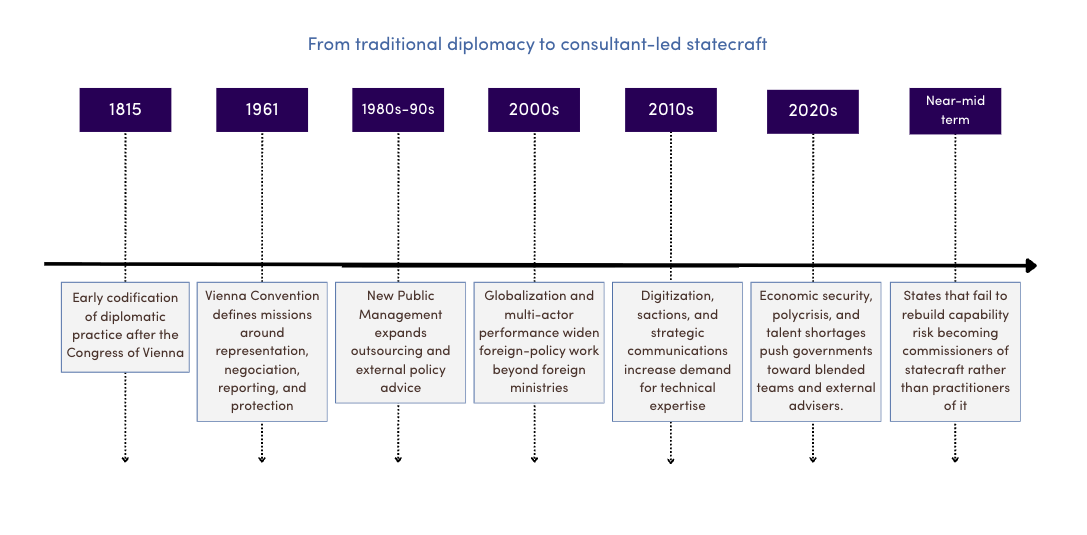
This timeline synthesizes the formal diplomatic baseline, the outsourcing turn in public administration, and the more recent shift toward economic and digital statecraft.⁷
Why This Should Worry Leaders
The first concern is accountability. The NAO warns that governments often lack a clear picture of their consultant spending because integrated contracts now bundle design, management, delivery, and contingent labor. That makes spending harder to classify, oversight harder to perform, and responsibility harder to assign. UK procurement guidance now requires contracting authorities to identify, review, record, and mitigate actual, potential, and even perceived conflicts of interest through the procurement lifecycle. The OECD similarly describes public procurement as a high-risk area because large financial interests and close public-private interaction create exposure to corruption, conflict of interest, mismanagement, and collusion.⁵
The second concern is democratic oversight. Marciano’s comparative research shows that consultants can become institutionalized in core policy formulation, directly shaping policy substance, procedural management, and legitimacy. Ylönen and Kuusela go further, arguing that consultocracy can privatize public knowledge, create dependency, erode tacit knowledge, weaken accountability, and normalize rapid reforms driven by private-sector logic rather than bureaucratic responsibility and democratic consensus. That is the real constitutional issue: not whether governments buy expertise, but whether external actors end up framing the problem, drafting options, helping choose among them, and then evaluating the results.⁸
The third concern is national security. SWP’s analysis of sanctions statecraft shows diplomats struggling to keep pace with increasingly sophisticated economic sanctions, while finance ministries and other specialist actors take over functions once central to diplomacy. RUS’s work on sanctions circumvention shows why private-sector engagement is not a theoretical risk: professional service providers can become “enablers” that help sanctioned actors hide assets, use shell structures, and exploit regulatory gaps. Even where no misconduct occurs, the fact that U.S federal procurement rules explicitly require controls for contractor personnel performing functions closely associated with inherently governmental work is a reminder that impartiality simply cannot be assumed.⁹
What This Means for Statecraft
The practical implication is that ministries increasingly behave less like sovereign producers of diplomatic judgment and more like orchestrators of external capability. In the best case, that creates agile, cross-functional statecraft. In the worst case, it produces a state that can commission a strategy but not own it. Once institutional memory, technical fluency, and policy modeling sit outside government, ministers retain formal authority while losing substantive control over how options are generated and operationalized.⁵
This matters most in economic diplomacy and geoeconomics. Carnegie’s work on the EU shows that economic statecraft now requires much tighter coherence between internal and external policy, yet institutional capacity to connect those worlds remains insufficient. That is a warning well beyond Europe. As statecraft becomes more regulatory, technical, and economically coercive, the premium on actors who can model complexity quickly rises. If governments do not build those capabilities themselves, consultants will continue to fill the gap—and to shape the strategy at the same time.³
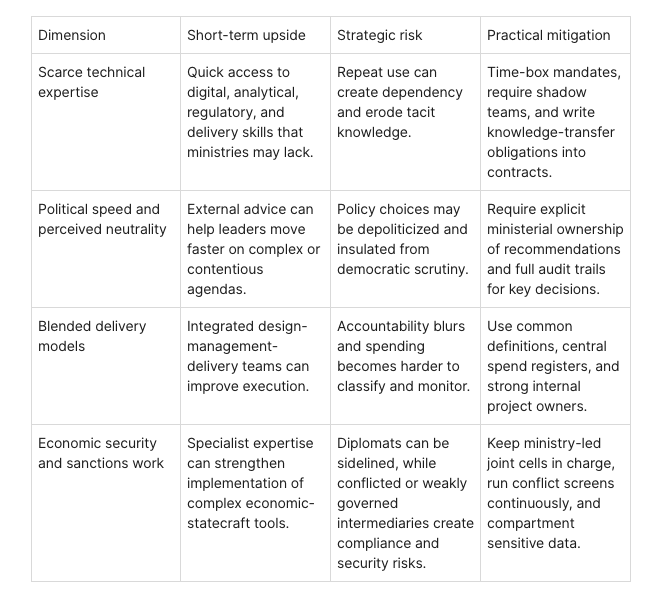
Comparison Table
What Clients Should Do
Define the sovereign core. Governments should decide explicitly and early which functions are inherently governmental and must remain within the state: negotiating positions, sanctions design, intelligence-adjacent assessments, cabinet submissions, diplomatic signaling, and final policy trade-offs. External advisers can support these activities, but they should not own them.¹¹
Govern conflicts like strategic risks, not legal formality. Conflict mapping could cover actual, potential, and perceived conflicts; outside interests; connected entities; and whether the same advisory firm appears elsewhere in the policy ecosystem. The point is not only probity. It is preserving trust in the legitimacy of state decisions.¹⁰
Buy capability creation, not just deliverables. If an engagement does not leave behind staff capability, reusable methods, documented assumptions, and internal owners, it is not solving a capacity problem; it is renting one. Contracts should include structured knowledge transfer, active co-working, and measurable reductions in repeat demand.⁵
Create internal mission offices for cross-cutting statecraft. The OECD’s recent work on mission-oriented policy emphasizes dedicated public-sector capability in foresight, systems thinking, portfolio management, and collaborative leadership. Ministries facing economic-security or complex interdependence agendas should institutionalize those functions rather than perpetually outsource them.¹²
Make transparency operational. Maintain a central register of advisory mandates, scope, spend, conflicts assessments, datasets accessed, and outputs produced. Senior officials and legislatures cannot oversee what they cannot see; the NAO’s recurring finding is that poor data weakens both value-for-money control and dependency management.⁵
Keep diplomats in the lead in economic statecraft. As sanctions, export controls, industrial policy, and investment screening move closer to the center of foreign policy, ministries should embed economic, financial, and technical specialists inside diplomatic teams rather than ceding the field to outside advisers. Otherwise, governments will discover too late that they have outsourced not only expertise, but strategic government.⁹
Toward Collaborative and Accountable Partnerships
Ultimately, the most effective approach to modern statecraft is not a zero-sum competition between public and private actors, but a thoughtful collaborative framework that leverages the strengths of both. When governments establish clear boundaries and engage in sovereign decision-making, foster genuine knowledge transfer, and maintain rigorous transparency and oversight, external consultants can become valuable partners rather than substitutes for public capability. When done correctly, a public-private partnership enables states to access specialized expertise and surge capacity without eroding institutional memory or democratic accountability. Such collaboration ensures that both public interests and private innovation are aligned in the service of more resilient, adaptive, and effective policy outcomes.